
Everyone in Scituate has a version of the same story. The wind picks up, the lights flicker twice, and then the house goes quiet. Sometimes it comes back in an hour. Sometimes it is the next day, or the day after that, and by then the heat is off, the sump has stopped and the freezer is a question mark.
Coastal towns lose power more often and for longer, and the reasons are structural: wind loading on lines, salt spray on equipment, trees, and flooding that makes some streets hard to reach with a bucket truck. Nothing about that is going to change. What can change is whether your house cares.
What an outage actually costs you
- Heat off in cold weather, with the added risk of pipes
- No water at all if you are on a well, because the pump is electric
- A sump pump that stops while water is still coming in
- Refrigerator and freezer contents on a clock
- No internet, no home office, no charging for medical equipment
- Sewage ejector or septic pump systems out of service
The transfer switch is the part that matters
People shop for generators and think about wattage. The component that makes a generator safe is the transfer switch. It isolates your house from the utility lines while the generator is running, so generator power cannot travel back out onto the grid.
That matters for two reasons. It protects the line crews working to restore your neighborhood, who have every right to expect a de-energized line. And it protects your own equipment when utility power returns, by managing the handoff instead of letting two sources meet.
This is why running a generator through an extension cord into a dryer outlet, sometimes called back-feeding, is so dangerous. It energizes your panel and everything connected to it with no isolation at all. It is not a shortcut, it is a hazard to you and to the people fixing your power.
Standby or portable
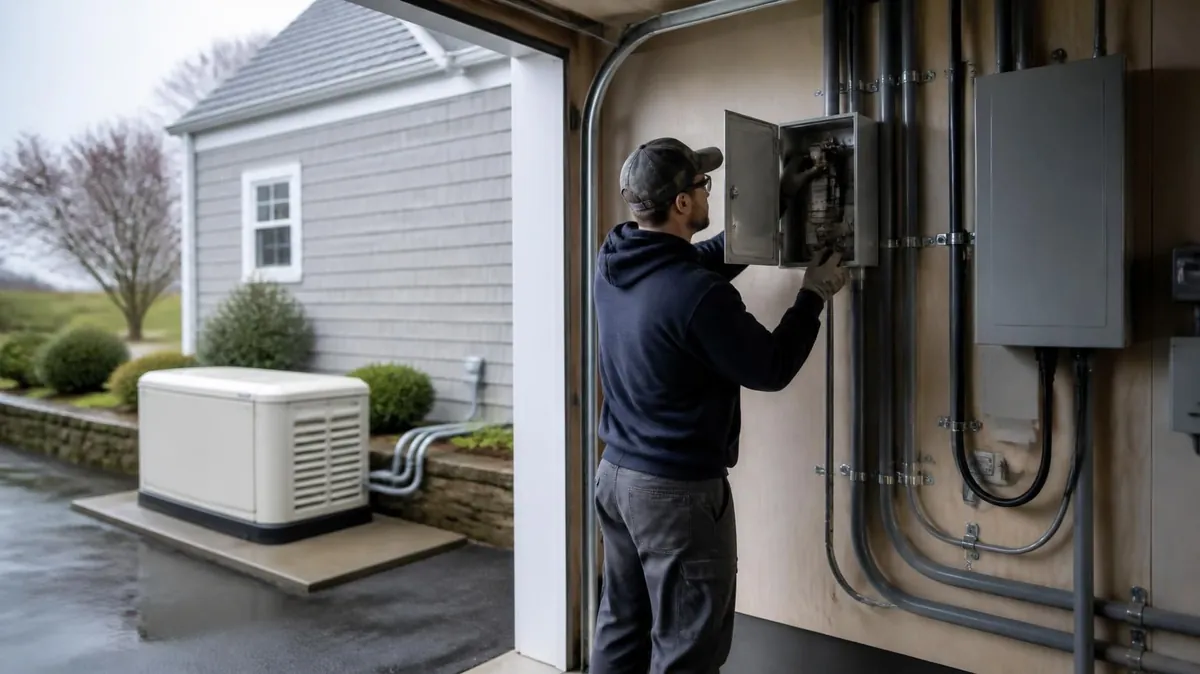
A standby generator is permanently installed, runs on natural gas or propane, and with an automatic transfer switch it starts itself when the utility drops and shuts down when power returns. Nobody has to be home, and nobody is outside in a nor'easter with a cord.
A portable generator costs less up front and it is genuinely useful, but someone has to be there to set it up, fuel it and manage it, and it only powers what you can reach. In a long coastal outage, the difference between the two is mostly whether you are managing the problem or it is handled.
Sizing it honestly
Oversizing wastes money. Undersizing means you trip out the first time the well pump and the heat call at the same moment. The right way to do it is to decide what has to stay on, then size to that: typically heat, water, the sump pump, refrigeration and essential lighting and outlets. Whole-house coverage is available if that is what you want, and it should be a decision with a number attached, not an assumption.
What a proper installation includes
A load assessment, the generator sited for clearances, exhaust, noise and coastal exposure, the transfer switch installed and wired correctly, the fuel connection coordinated, any panel work the install requires, the permit pulled and the town inspection scheduled, and a tested handoff so you have actually seen it run under load. Then a walkthrough, so you know exactly what happens the next time the lights flicker twice.
Frequently asked questions
Electrical Emergency? We Answer 24/7.
Burning smell, sparking outlet, hot panel or sudden power loss? Boston Light & Power provides 24/7 emergency electrical service across Boston, Milton, Quincy, Braintree, Weymouth, Hingham, Scituate and Cohasset. Licensed electricians, every hour of every day.
Call (857) 855-7899 NowBefore the next nor'easter
We will size it, install it, permit it and test it so you know it works. Call (857) 855-7899.
Related pages
Boston Light & Power serves Boston, Milton, Quincy, Braintree, Weymouth, Hingham, Scituate, Cohasset, Hanover and Norwell. Master Electrician license 24281-A, fully insured, 5.0 across 85 Google reviews.