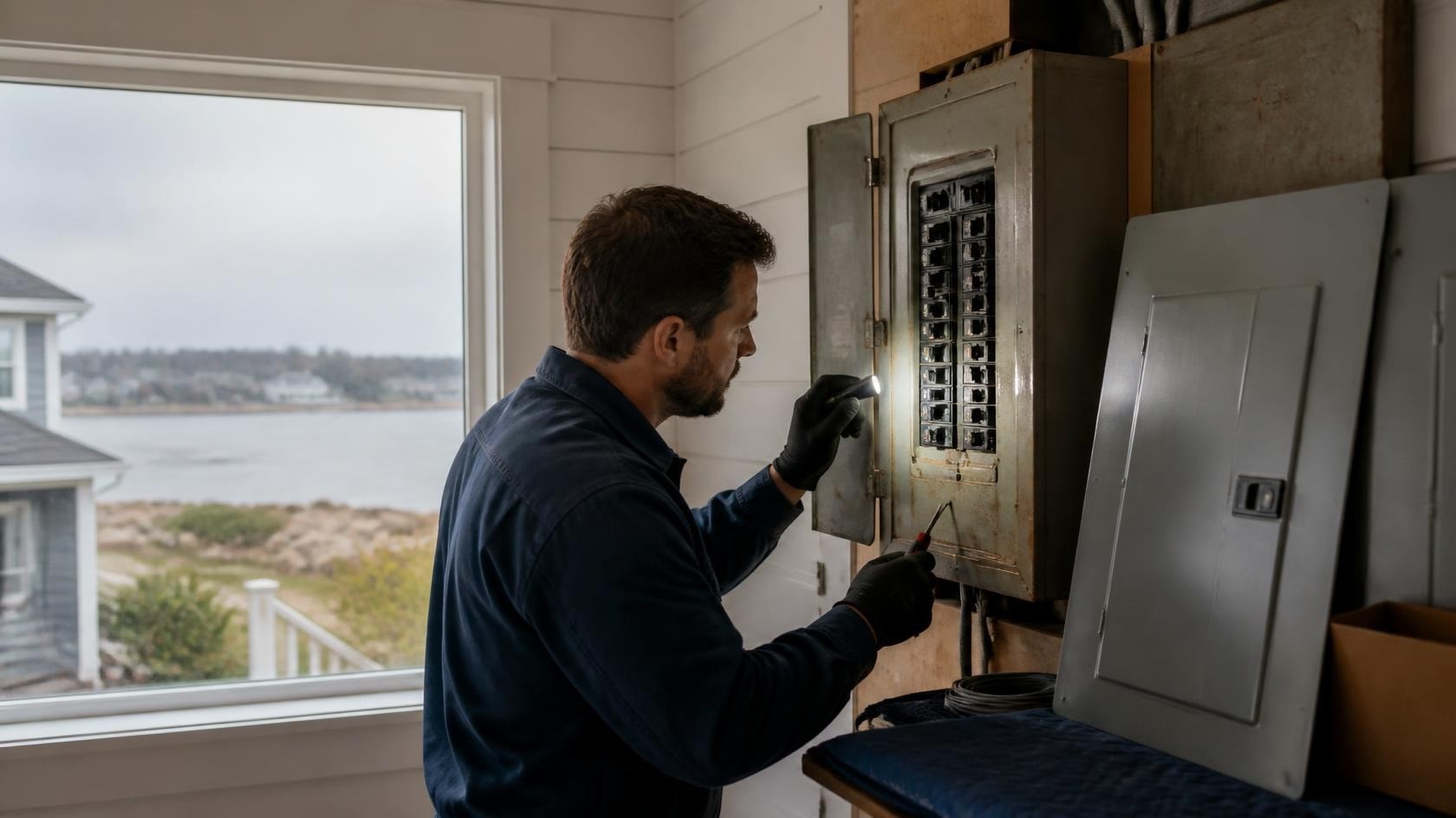
Two houses, same builder, same year, same panel. One is in Cohasset a few streets from the water. The other is fifteen miles inland. Twenty years later the inland panel is fine and the Cohasset panel has rust at the bottom, white residue on the bus bar and a breaker that runs warm. The difference is the air.
Salt does not stay in the ocean. It travels in fog, wind and spray, and it settles on everything, including the inside of an electrical panel. Panel enclosures are not sealed containers. Air moves through them, and whatever is in that air ends up on the metal that carries your power.
What salt actually does inside a panel
Electricity depends on clean, tight metal-to-metal contact. Salt corrosion attacks exactly that. It builds up on the bus bar, on breaker contacts, on lugs and terminations, and on the screws holding everything together. You see it as white or green powder, chalky film, or rust creeping up from the bottom of the can.
Corroded contact adds resistance. Resistance makes heat. Heat expands and then loosens the connection, which adds more resistance, which makes more heat. It is a loop that gets worse on its own, and it is the reason coastal panels fail in ways that look sudden but were years in the making.
The part homeowners cannot see
With the cover on, a corroding panel looks like a clean gray box in the basement. Everything works. Lights come on. Nothing smells. The damage is on the other side of that cover, which is why we open panels as a matter of course on coastal service calls instead of waiting for a complaint.
It is not just the panel either. The meter socket outside, the service entrance, exterior disconnects and any outdoor receptacle are all in the weather full time. Corrosion at the meter socket is a particularly bad find because it sits between you and the utility, and it tends to become an emergency rather than a project.
Signs worth acting on
- Rust, or white or green residue, anywhere inside the panel
- A breaker that is warm to the touch, or one that trips repeatedly
- Buzzing, humming or crackling from the panel
- Lights that dim when the well pump or air conditioning starts
- Discoloration or scorch marks around a breaker or a screw terminal
- Any burning smell near the box, which is a stop-and-call-now item
Do not remove the panel cover, touch internal parts, or attempt to clean corrosion yourself. Have a licensed electrician inspect it. If you see smoke or fire, leave the home and call 911.
How long should a panel last on the coast
There is no single number, because it depends on distance from the water, exposure, how well the original install was sealed and whether the equipment was suited to the environment. What we can say from working here is that coastal panels routinely show meaningful corrosion well before an inland panel of the same age shows anything at all. If your home is near the water and nobody has opened the panel in ten years, it is worth doing.
What a good coastal replacement looks like
Replacing a corroded panel is not just installing a new box in the same spot. Sizing comes first, because most older Cohasset homes are now running loads nobody planned for. Then the install details determine whether the new panel ages well: appropriate enclosure and hardware for a marine environment, connections torqued to specification, proper sealing where conduit enters, and checking the meter socket and service entrance while everything is open.
Skip those and you get a panel that looks new for a while and then corrodes on the same schedule as the last one. That is a cost you pay twice.
Frequently asked questions
Electrical Emergency? We Answer 24/7.
Burning smell, sparking outlet, hot panel or sudden power loss? Boston Light & Power provides 24/7 emergency electrical service across Boston, Milton, Quincy, Braintree, Weymouth, Hingham, Scituate and Cohasset. Licensed electricians, every hour of every day.
Call (857) 855-7899 NowIf you are near the water in Cohasset
Have the panel opened and looked at by a licensed electrician before it forces the issue. We can tell you in one visit whether you are fine, whether you are on a watch list, or whether it is time. Call (857) 855-7899.
Boston Light & Power serves Boston, Milton, Quincy, Braintree, Weymouth, Hingham, Scituate, Cohasset, Hanover and Norwell. Master Electrician license 24281-A, fully insured, 5.0 across 85 Google reviews.